How to Combine Brick and Stone Without a Busy Exterior
Pair brick and stone without competing patterns. Choose a lead material, compare mortar and undertones, and place stone where the architecture needs it.
Brick and stone can both be beautiful and still look wrong together. The problem is often not the quality of either material: both are trying to carry the color, texture and pattern of the house at once.
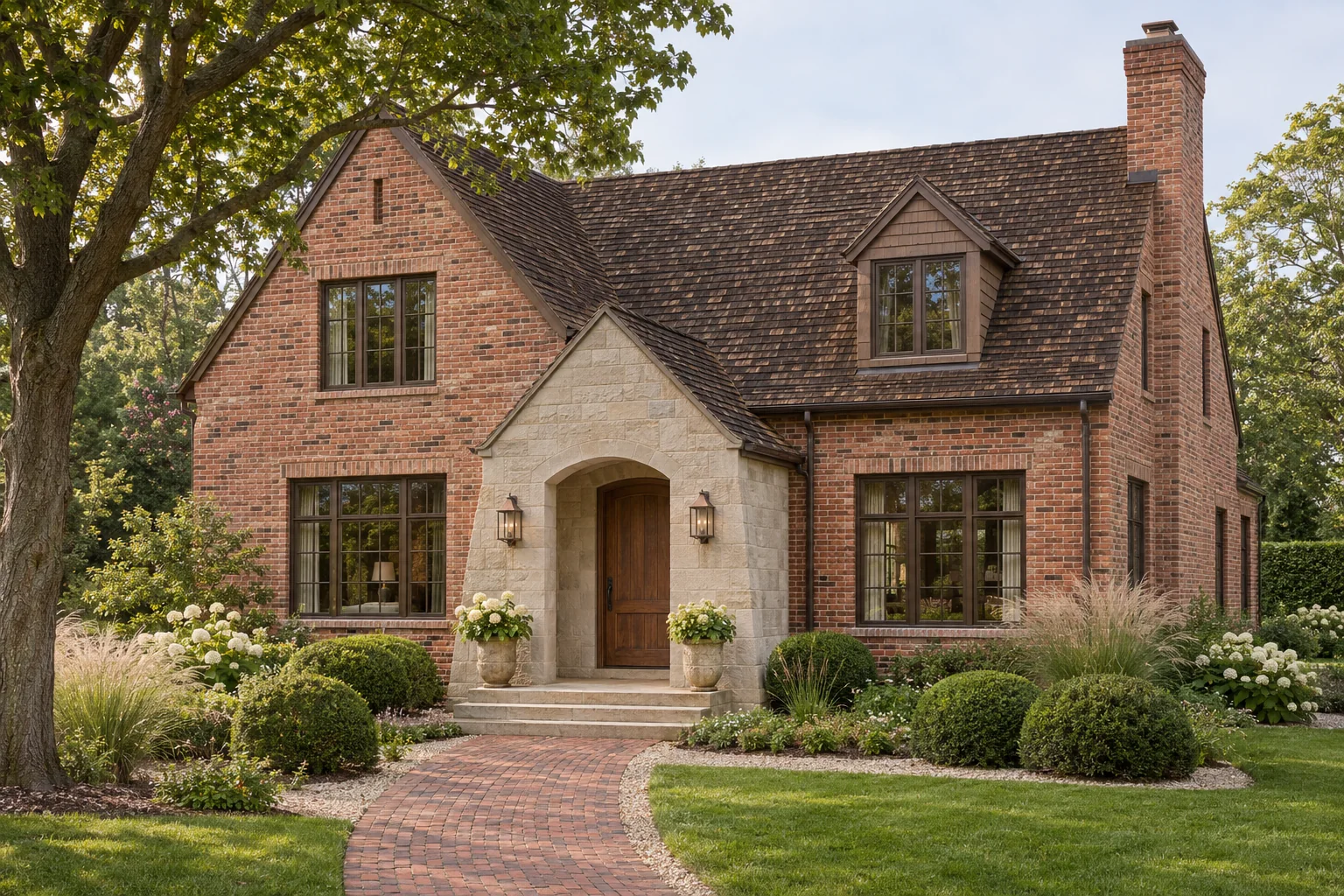
Start with one decision: which material leads? In this English-country-inspired study, warm brick covers most of the home and the pale stone is concentrated at the entrance. The two materials have different roles, so the eye has somewhere to rest. This is a design study for comparing choices, not a record of completed client construction.
If the brick is staying, choose the stone second
Look at a whole wall of your existing brick, including the mortar. Notice whether it reads predominantly orange, red-brown, purple-brown or muted buff from the street. Then inspect the range of individual bricks up close. A stone sample that matches one unusual brick may clash with the overall wall.
For the warm red-brown brick shown here, a quieter limestone-like neutral offers contrast without adding another strong color. A highly varied stone mixing rust, charcoal and cream would introduce several more relationships to solve. It may be beautiful on its own, but that is not enough reason to place it beside this brick.
Separate contrast in color from contrast in pattern
You do not need brick and stone to be nearly identical. A pale entrance can stand out against darker brick while remaining calm if its individual stones are relatively consistent. Here, the difference in lightness makes the entrance easy to find.
The risk rises when both surfaces have strong internal variation: mottled brick beside multicolored rubble stone can create two busy patterns. Try reducing one variable. Keep the brick’s variation and choose quieter stone, or let expressive stone lead while the surrounding wall becomes simpler.
Give the stone an architectural boundary
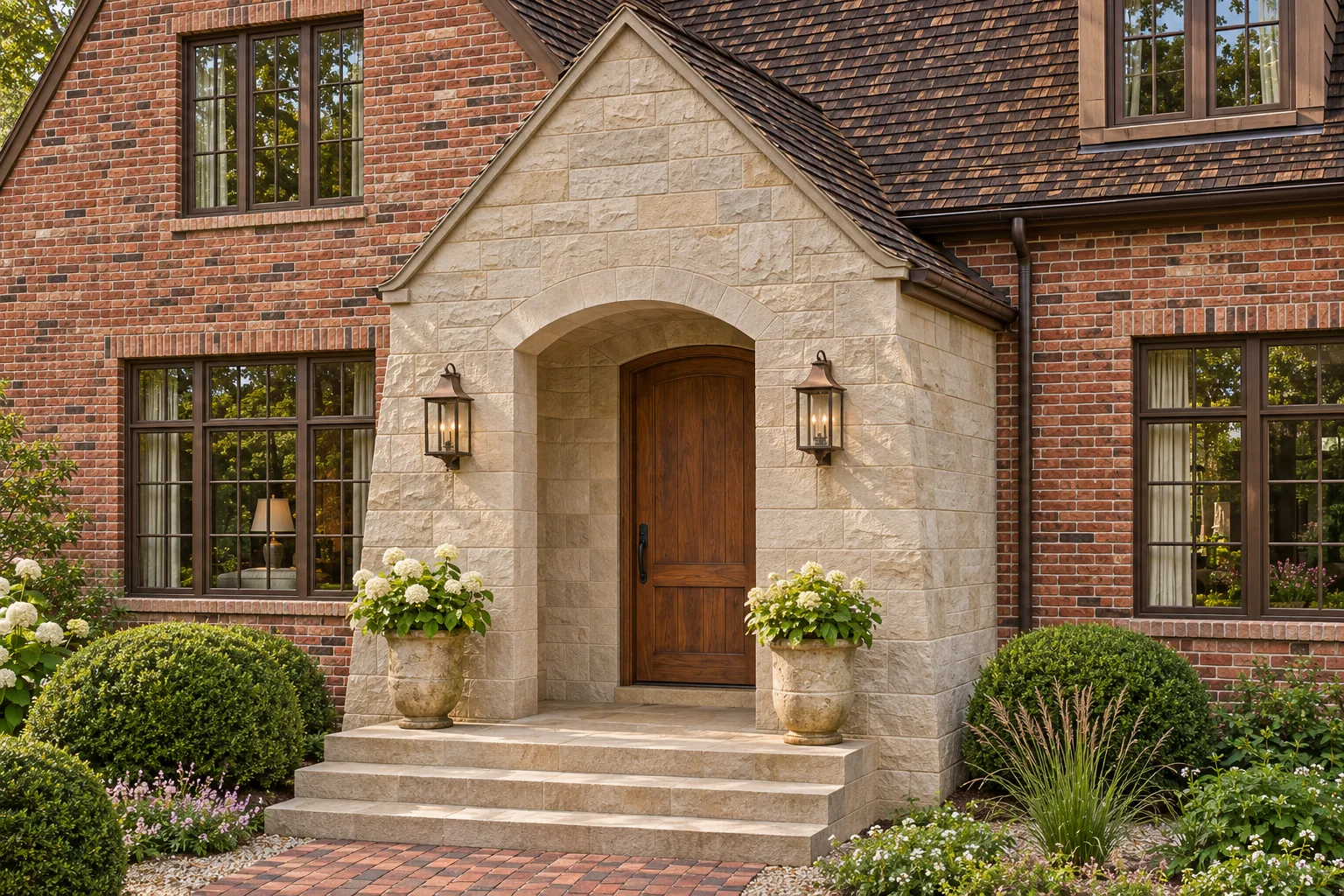
The stone in this study forms a complete entrance volume with visible depth and an arched opening. It starts and stops at a change in the building, not at an arbitrary line drawn across a wall. That makes it read as part of the architecture.
Before adding stone to a flat area between windows, ask what that patch explains. Does it identify an entrance, base or projecting part of the house? If the answer is only “the wall needs something,” compare a simpler option first. A better door, clearer window trim or more coherent wall color may solve the problem without another masonry pattern.
Ask the designer and installer how the material continues around corners and meets openings. Thickness, support, water management and transitions must be resolved for the chosen system; a rendering is not a masonry construction detail.
Compare the mortar, not just the brick and stone
Mortar is visible across the entire wall, so it affects how light, warm and patterned the masonry appears. The Brick Industry Association demonstrates how different mortar colors change the appearance of the same brick. A brick sample without its intended joint can therefore give an incomplete impression.
For new work, request a representative panel that includes the actual units, mortar and joint treatment. SPEC MIX recommends using all representative materials and allowing a sample panel to cure before approval. Compare the brick and stone assemblies together in outdoor light rather than approving them independently from small photographs.
If existing mortar is staying, treat its color as a fixed part of the palette. Do not assume it can be replaced simply to make a new stone selection fit.
Keep the remaining finishes quieter
The brown roof, restrained window frames and timber door support the masonry in this study. None needs to introduce a third competing pattern. The garden also leaves the entrance visible instead of placing several decorative features immediately in front of it.
On your house, check the roof first because it occupies such a large area. A cool gray roof may call for a different stone balance than a warm brown one. Then review windows, trim and paving. If every selection is a feature, the brick-and-stone relationship will never feel settled.
When the better choice is no new stone
If your brick already has rich variation, a strong entrance and good proportions, more stone may not add value to the design. Keep the masonry and improve the surrounding details instead. On a smaller home, even a modest new patch can occupy a surprisingly large share of the front view.
For a new build, compare a brick-only elevation with the mixed-material option before ordering. For a renovation, place the proposed stone beside a photograph and physical sample of the retained brick. Choose the combination that makes the entrance and overall form clearer—not the one with the greatest number of premium materials.